Traditional zero trust security models are built on the assumption that systems operate in discrete, predictable steps. However, the rise of agentic AI, where autonomous agents act continuously and make real-time decisions, challenges this paradigm. Instead of replacing zero trust, we must evolve it into a continuous trust model. Below, we explore how agentic AI changes security requirements and what organizations can do to adapt.
What is the core principle of zero trust and why does it fall short for agentic AI?
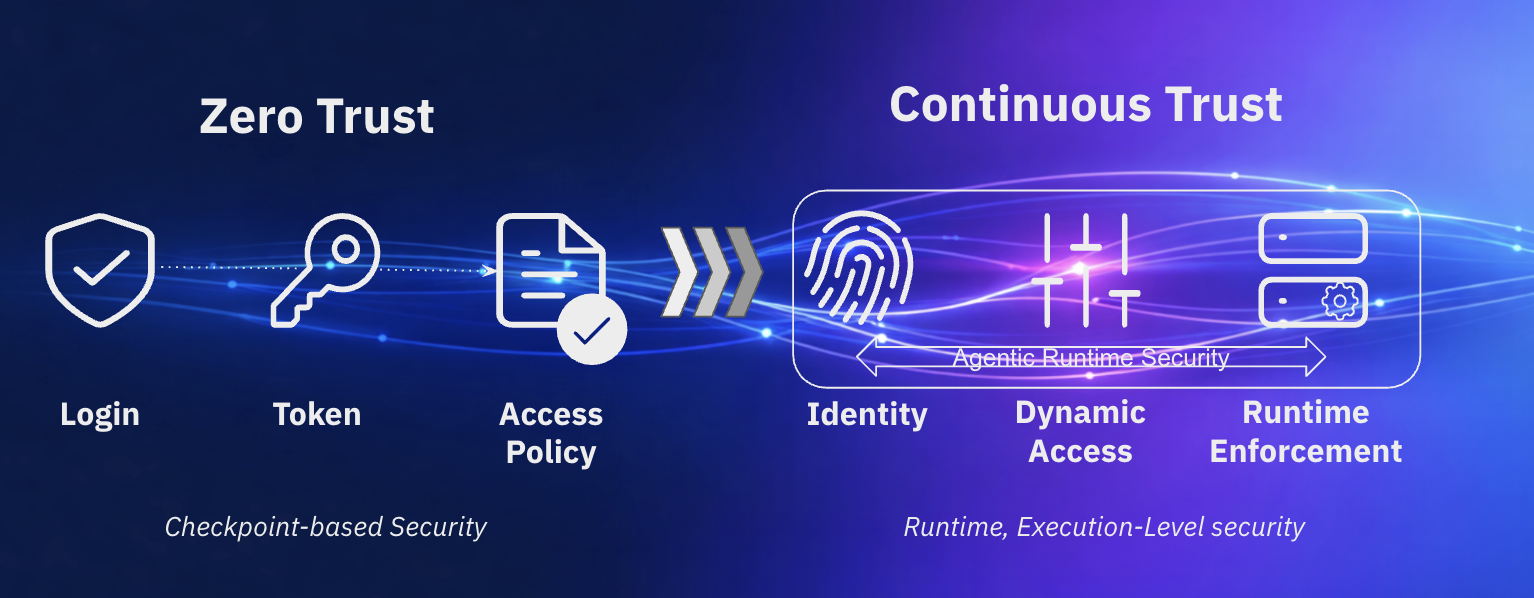
The core principle of zero trust is “never trust, always verify.” In traditional environments, trust is evaluated at defined checkpoints: a user authenticates, a token is issued, and access is granted within a fixed scope. These checkpoints work well when behavior is relatively predictable. However, agentic AI systems operate differently. An agent begins a task and then continuously interacts with its environment—calling APIs, requesting access, generating credentials, and moving from one step to the next without pausing. There are no natural breakpoints for re-evaluation. Trust is not a moment; it is a flow. As a result, the discrete verification model of zero trust breaks down. The system is always in motion, and security must move with it rather than relying on isolated trust decisions.
How do agentic AI systems differ from traditional systems in terms of authentication?
In traditional systems, authentication is a one-time event. A user logs in, a service authenticates, and a token is issued. That token then grants access within a defined scope for its lifetime. Agentic AI systems, by contrast, do not follow this linear pattern. An agent may request elevated permissions, generate a credential, call a downstream service, and modify infrastructure—all within fractions of a second. Each action introduces new context, permissions, and dependencies. Access is no longer provisioned and later used; it is created and consumed simultaneously. Credentials may be issued for a specific step, used immediately, and replaced as the workflow evolves. This dynamic process makes static roles and long-lived permissions obsolete. Authentication becomes a continuous, context-sensitive activity rather than a single checkpoint.
Why are dynamically issued credentials essential for securing agentic AI?
Dynamically issued credentials are essential because they align access exactly with what an agent is doing at that moment. In traditional zero trust, tokens or API keys are issued with a fixed scope and a set lifetime. But agentic AI workflows evolve in real time—new tasks spawn new sub-tasks, each requiring different permissions. Static credentials become a liability: they either grant too much access for too long or require frequent manual rotation. Dynamically issued credentials, such as those provided by systems like HashiCorp Vault, are short-lived and scoped per action. They are generated on demand, used immediately, and automatically revoked after use. This minimizes the risk of credential misuse and ensures that access is always tightly coupled with current behavior, not past assumptions.
How does the relationship between access and behavior change in agentic systems?
In traditional systems, access and behavior are loosely coupled: access is granted first, and then actions follow. This separation allows security teams to enforce policies at entry points and monitor behavior afterward. In agentic AI systems, access, identity, and behavior become continuously intertwined. An agent’s next action determines what access it needs, and that access is obtained immediately as part of the action. Over time, this creates access paths that were never explicitly designed or reviewed. For example, an agent might request elevated permissions to complete a task, generate a temporary credential, call a downstream service, and modify infrastructure—all in rapid succession. Security can no longer rely on pre-defined roles or static boundaries. Instead, it must understand and verify each action in its immediate context, merging authorization and activity into a single, continuous trust evaluation.
What role does HashiCorp Vault play in this new security paradigm?
HashiCorp Vault exemplifies the shift from zero trust to continuous trust by providing dynamically issued, short-lived credentials that are scoped to specific workflows. In agentic AI environments, Vault can integrate directly with agents to issue secrets on demand, aligning access with current tasks. For instance, when an agent needs to call an API, Vault generates a temporary token with the exact permissions required, which is used immediately and then expires. This eliminates the need for long-lived credentials and reduces the attack surface. Vault also enables fine-grained auditing and policy enforcement at each step, so security teams can track every access request. By decoupling credential issuance from static provisioning, Vault supports the continuous, context-aware security model that agentic systems demand.
How should organizations evolve their security strategies from zero trust to continuous trust?
Organizations need to move beyond discrete trust checkpoints and adopt a model of continuous trust. This evolution does not discard zero trust principles but extends them. Key steps include: (1) implementing dynamic credential management, as seen with HashiCorp Vault, to issue access only when and where needed; (2) using real-time behavior monitoring and anomaly detection to assess trust continuously rather than at login; (3) designing policies that can adapt to unplanned access paths; and (4) integrating identity, access, and behavioral analytics into a unified framework. Additionally, security teams should embrace automation to enforce policies at machine speed, since manual intervention is impractical for rapid agent workflows. By treating trust as a fluid property that must be verified with every action, organizations can secure autonomous AI systems without hindering their agility.